Showing posts with label Black superhero. Show all posts

Black Lightning Finale Misfire

The era of the televised black superhero television series has come to an end, or at least for now, it has with the series finale of the CW's Black Lightning. After four seasons, the Pierce family is saying goodbye, and with news of the Painkiller series not being picked up this will perhaps be the last time we see the full cast together. Complete series finales are always a hit and miss, and unfortunately, the Black Lightning finale was a miss. For every the Wire and Golden Girls, there’s a Lost or Game of Thrones and the CW show follows the latter. There’s a lot to look into when considering what lead to the ending of the series. If not the leaving and recasting of a day one series regular, and a loyal fan base, the only thing that could have derailed the momentum of the show is the CW network itself, and its lack of interest. 

Black Lightning premiered at a time when the Black male superhero was in high demand. The character Black Panther stole the show in Captain America Civil War and was on the way to having the highest-grossing film for marvel at the time, and Luke Cage was receiving rave reviews for its debut season on Netflix. Even minor characters were being featured in shows such as Runaways, the Flash, and Arrow. Black superheroes were everywhere once, but despite the critical reception at the time black superheroes are now scarce when it comes to television. Luke Cage was canceled after two seasons, and the world suffered the loss of Chadwick Boseman changing the entire direction of the Black Panther Franchise. Even minor black superheroes such as Kid Flash, and Vixen, from Flash and Arrow, have been shelved, and with the cancellation of Black Lightning, Batwoman is officially the only series airing featuring a predominant black superhero. (More on the future of the black female superheroes to come.)

The network seems to have lost faith in the future of the series, and black male superheroes altogether. While the series attempts to tie all threads together nicely, the finale suffers from having too much too soon. As Charles Pullium-Moore pointed out in his piece the hour alone isn’t enough time to service and send off each character successfully, and many major points feel packed and rushed to fit into the finale. And while the finale attempts to plant seeds of the future, news of the Pain Killer series not being picked up diminishes any hope of seeing the heroes in the future.


With this said, Black Lightning definitely deserves its flowers. The series set a precedent for incorporating real-life issues into its storylines, beyond the go-to trauma story of near-death encounters between police and African American characters. Throughout the seasons the series touched on gentrification, the school to prison pipeline, illegal health experimentations, inner-city gang violence helping to keep the series grounded in a sense of reality missing from most of its CW peers. The villains were just as captivating as the series heroes, and no hero was above being believably flawed. And while the show originally played into the trend of capitalizing off the popularity of the black superhero the series was also the first series to showcase black female superheroes predominately. Unfortunately, for all the good the series has presented the finale definitely tarnishes its legacy. 


What do you think? Are you glad the series has ended? 

Batwoman Earns its Wings


When the CW announced Javicia Leslie as the newest Batwoman the network knew it was entertaining an uncharted territory with a list of firsts. Leslie’s casting makes her the first-ever African American woman to lead a comic-based series, play Batwoman, and for extra merit, as a proud member of the LGBT community, she is the first lesbian woman of color to lead a series also. 

The season 2 premiere doesn't waste any time jumping into the action and fixing the series Kate Kane problem. It’s not long before Leslie’s character Ryan is introduced and we see that season 2 is going to be a very different show. Season 1 of Batwoman dragged primarily due to Rose’s character being outshined by virtually all of her costars and the fact that she was never relatable as a hero, so the new season wastes no time making the audience connect with the character of Ryan. Writers thankfully have avoided using any type of stereotypical tropes that usually befall Black characters in urban settings, especially in a crime-filled city like Gotham. Instead, writers have opted for presenting Ryan as a once optimistic resident of Gotham whose life is drastically changed after suffering a great tragedy. And yet the tragedy doesn’t turn her into an angry one-dimensional character. She has the much-needed personality that was missing in season one to match the energy of costars Campus Johnson and Nicole Kang, as well as the commanding presence needed to wear the Batsuit and terrify criminals throughout the city. Not to mention the relationship she has with her plant is the cherry on top.

Already I'm loving the direction season two is taking. In regards to the dynamic between the hero and villain, I'm already more invested in the relationship between Ryan and Alice as compared to the first season with Kate. Acknowledging the writers were trying to parallel the Batman and Joker dynamic, the reason people tuned into season one was to see what made Batwoman unique, not for the female version of Batman. 

With Luke Cage canceled on Netflix, and Black Lightning airing its final season, Leslie's Batwoman couldn't have come at a better time to fill the growing void of Black superheroes on television. Here’s hoping the series is here to stay. 


Hawkman Goes Black Finally


DC Comics Black Adam film is adding a new member from the Justice League and bringing another powerful Black superhero to the big screen. While the film stars Dwayne Johnson as the titular hero, legacy character Hawkman is finally heading to the big screen and will be played by actor Aldris Hodge. 

Hodge is no stranger to comic-inspired series, most recently appearing in season 2 of Netflix’s The Umbrella Academy. Touchingly it was Johnson who personally delivered the news to Hughs the casting decision. An account he shared in an Instagram post.
A member of the Justice League, Hawkman is an Egyptian man who, aside from flight, has the power of reincarnation. While not as well known as the big 7 of DC comics, the character is actually a key figure in the comics and has appeared in animated series such as Justice League and Young Justice,  and made a live-action yet ill-fated appearance in the CW Arrowverse. 

As with all recent comic casting involving persons of color, there is of course some backlash. Despite the character's initial background being written as biracial, the character was predominantly drawn to be a white man. Similarly, all of the previous live-action depictions leaned into whitewashing the character. Even when the character's history was taken into account and made a focal point of the storyline the casting still bypassed an actual person of color so if it’s the authenticity that anyone wants to complain about it should begin there. Between the casting of Hodge and Johnson, all signs are pointing to a storyline that’s conscious of the importance of the history of its characters. DC has proven that they can make good movies and surely Black Adam won’t disappoint. 

Nia DaCosta Makes Marvel History


Marvel is making history once again with its cinematic universe and the Captain Marvel franchise. The first film introduced the character as the most powerful hero on the Avenger roster and was directed by Anne Boden, Marvel’s first female director, with Ryan Fleck. While the film was a box office smash it was met with mixed reviews from fans and critics alike so perhaps Marvel is looking to take the film in a new direction with a brand new director. The company has hired Nia DaCosta to direct the sequel to Captain Marvel making her the first African American female director in the franchise.

Dacosta emerged on the scene with the success of her debut film Little Woods, and if her name sounds familiar it could be because she's also directing the highly anticipated reboot of Candyman. There's no telling what direction DaCosta is taking the film in but she is sure to bring a fresh take to film and could bring the much-needed life support needed for a trilogy. A makeover wouldn't be so bad especially when considering it took the Thor franchise three tries before it finally found its footing. It’s also worth noting that Netflix recently made history for hiring its first African  American woman to direct a comic adapted film, garnering rave reviews for its film The Old Guard and showing the industry Black women can produce great action films also.

Aside from her history-making hiring, DaCosta also has received the largest budget to ever be handed to a Black female director. Not much is known about the storyline however the movie will supposedly follow after the events of Endgame and will be set on Earth at some point to connect the movie with the upcoming series WandaVision which will introduce the adult version of Monica Rambeau. In all the future is looking bright for both Marvel and DaCosta. 


Blade Rebooted Starring Mahershala Ali


Fifteen years after the final installment, Marvel is ready to rebrand the Blade franchise and fully incorporate the hero into the MCU. The three previous films starred Wesley Snipes and when news first started circling many believed that the actor would be reprising the role. However, it has been officially announced at the San Diego Comic con that the franchise is getting fresh blood with the casting of Mahershala Ali as the titular hero. Ali is no stranger to Marvel, having previously portrayed the villain Cottonmouth on the Netflix series Luke Cage, and has gained a large fanbase thanks to his role in the movies Moonlight, and The Greenbook, so this only adds to the buzz surrounding the future film.

Given how tightly woven the MCU is, and the theory that Spider man will be the anchor of the universe, my first thought was that the best villain choice would be Morbius, a character who has crossed paths with both Blade and Spider Man in the comics. This is tricky given that Jared Leto is currently cast as the character for a stand alone film by Fox set to debut next year but with Marvel you never. know. Of course, since the original Blade trinity practically chronicled the life of Blade's mentor Whistler Marvel could opt to focus on the hero's origin. Details are scarce at this point, and even with the announcement of the 8 films of Phase 4 Blade isn't listed, so we probably won't see anything until late 2020 or early 2021 potentially making it part of Phase 5.

The original Blade trilogy grossed more than a combined $415 million at the box office and paved the way for the modern day superhero movie genre.

Building the Lightningverse

Related image
Black Lightning, the CW's latest superhero feature and first featuring an African American as the lead, has impressed fans and critics alike since its premiere and will officially return for a second season October 9th on the CW. While it was previously stated that Black Lightning isn't set in the primary Arrowverse, thanks to its filming in Atlanta instead of Vancouver like the other shows, however with the name dropping of heroes like Supergirl and Vixen, fans were teased early on and at least given an idea of at least what Earth the series takes place on. Now thanks to the upcoming crossover event we can expect the Black Lightning cast to finally be integrated into the full Arrowverse, along with the introduction of Batwoman.

While the Arrowverse has done a great job of blending its many heroes in episodes and crossover events they don't primarily deal with the issues Black Lightning has touched thus far. That being said, maybe it's time for a new universe of heroes with Black Lightning as its anchor and here are just a few heroes who will fit perfectly into the series.
Image result for static shock1. Static (Virgil Hawkins) 
Probably the most expected, and anticipated, addition fans want to see and who can effectively expand the universe is Static. When news of a new CW potential first emerged many hoped it would be Static as the titular hero, however, there's no reason the two can't share the screen together. Hosting the same powers of Black Lightning, it would be interesting to see the two team up, with Static as a potential protege. 

Image result for bumblebee young justice
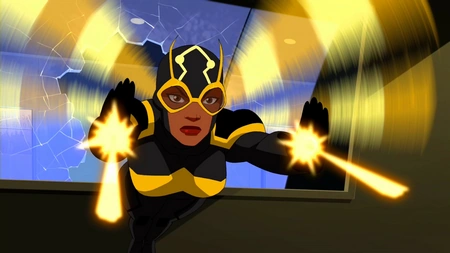
2. Bumblebee (Karen Beecher) 
After successfully navigating Thunder's origin and highlighting her growth as a hero, season two has the potential to add more female heroes to an over much-lagging roster. Bumblebee would be a perfect addition to the series, as she would not only easily fits in the same age group as Lightning's daughters but also would be a brilliant creative addition thanks to her shrinking capabilities and scientific intelligence. While a perfect fit for the series, between the upcoming live-action Teen Titans and the Hasbro lawsuit, chances of seeing the heroine on screen, remains minimal.

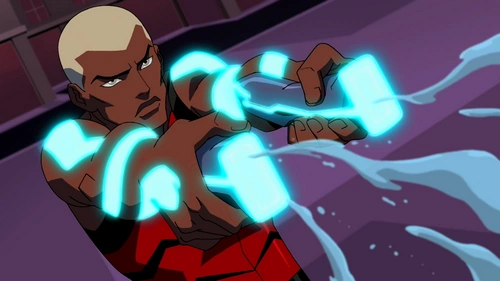
3. Aqualad (Kaldur'ahm) 
Even if Aquaman is off limits for television hopefully referencing Atlantis, even if only in name, is a great way for the series to set up an Aqualad appearance. Like Bumblebee and Static he fits the age group for rising heroes appropriate for the show, but like Bumblebee Aqualad too may be under restriction for use in Teen Titans.

Image result for aqualad young justice


Image result for luke fox batwing


4. Batwing (Luke Fox)

A member of the Bat-family who has yet to receive any mainstream attention, it's because of this that Batwing can be a great addition to extend the Black Lightning universe. Even if Batman remains off limits, given the time frame of the universe using Luke also fits the age group for the series exploring young heroes.

Image result for batman

5. Batman (Bruce Wayne)
 

Two longtime comic collaborators, while none of the Arrowverse series have yet to be able to feature the dark knight, the surprising Supergirl name drop in Black Lightning opened it to the realm of possibilities. Due to Arrow writers blurring the lines between the show and Batman, featuring the hero on another earth is the easiest and safest route for sake of continuity. Batman would easily fit into the more grounded reality of Black Lightning as compared to shows like Flash and Supergirl. 


Image result for black vulcan6. Black Vulcan
While the history involving both Black Lightning and Vulcan is slightly convoluted, as the latter essentially would not exist without the former. Thanks to a dispute between Black Lightning's creator and DC, the character was not authorized to be used for the DC comic inspired animated series The All New Superfriends. Because of this, and the need for a Black character led to the "creation" of Vulcan exclusively for the series. While I see this being played on a more comedic note, and is a biggest long shot of them all, seeing the two onscreen together would be priceless. 


Although Black Lightning has only begun to test the waters of delving into its own mythos adding in a few more dynamic characters won't hurt, and with the big crossover event coming this fall, there's no telling what the writes may have in store for viewers. Hopefully, as the series continues fans will get to see the Black Lightning universe expand to begin introducing new heroes to share the screen with. Whether it's for short-term story arcs or laying the groundwork for future series or appearances, introducing heroes like Black Canary, Firestorm, Vixen, and even the Flash have only helped to increase viewership and benefit the Arrowverse as a whole, and the same can be done for Black Lightning.

Year of the Black Superhero


2018 is shaping up to be another monumental year for readers of comics and fans of its televised and cinematic counterparts. This is especially true in the instance of Black characters. After 10 years ( 17 marvel films, 5 DC films) African American comic characters and superheroes are finally being brought to the forefront and leading their own films and series. Thanks to the critical success of the Netflix series Luke Cage, the Marvel execs may have finally realized that they can draw in Black viewers without the act of race bending characters in an effort to reflect "diversity" (i.e. raise ticket sales) and as a result 2018 will be the biggest year for African American superheroes to date.

Marvel is pushing fufther into its 'diversity' frontier preparing for the company's first feature starring an African American male as the lead with 2018's Black Panther. Completely stealing the show in Captain America: Civil war, Chadwick Bossman' s Black Panther is one of the most recognized and beloved Avergers surpassing Stark's technology, Banner's intellect, Thor's honor, and Roger's leadership. Premiering in February, the movie will follow his return to Wakanda, as he deals with the aftermath of the death of his father and his own ascension to the throne.

While it's no surprise that Luke Cage will return to Netflix with a second season next year, it isn't the only streaming service getting in on comic adaptations with Hulu also throwing its hat into the ring this November. The adaptation of the Marvel comic The Runaways will feature African American team leader Alex Wilder, a genius who learns that his parents are actually super villains.
And on the small screen things are growing even bigger for the CW as the network prepares for the premier of its new series Black lightning, based on the DC character, which will feature television's first primetime black superhero family. (http://unorthodoxwisdom.blogspot.com/2017/10/blacklightning-and-first-black.html?m=1)

Although there continues to be a lack of Black female super characters on television and film, this list will also grow with the inclusion of Black Lightning's daughters Thunder and Lightning, while The Legends of Tomorrow continues to brilliantly highlight the DC character Vixen, and Luke Cage will transition Misty Knight towards her heroic calling.
With each of these shows 2018 will be the year with the most black superheroes in movies and television, and if this is any indication of what's to come in the future then we are in for a spectacular ride. (Honorable mention to Arrow's John Diggle and Mr. Terrific, Guardian from Supergirl and the Flash's Wally West).

Is Avengers vs X-Men Happening?

Just when comic and superhero fans thought they neared the pinnacle of Comic adapted movies it has been revealed that Disney and Fox are finally in negotiations to give their fans what they've been waiting for all along. Disney and Fox studios are in talks to bring  return The X-Men to their rightful place in the marvel cinematic universe.

The X-Men are an important staple to the marvel universe, with several members even serving as Avengers over time. With 9 installments the franchise has been a hit and miss provoking a reboot to the franchise in hopes of correcting the inconsistencies and stark contrast from its source material. While the MCU has successfully dominated the superhero movie genre, and as exciting as this news may be, there have been the occasional missteps. Thanks to the separation of the X-Men from the established universe. For example, the retcon of Scarlet Witch and Quicksilver from being mutants in Avengers Age of Ultron and the non mention of the mutant Magneto being their father. There's also the issue of Quicksilver dying in the MCU, while simultaneously being introduced to the X-men universe during the 70s as a teenager and returning during the next installment set in the 80s.

The only remedy to this situation is likely to be the introduction of its own version of the multiverse. Previous mistakes aside, hopes remain high that negotiations end well with the X-men joining the MCU, as the next great storyline that can both  top the civil war storyline and appropriately incorporate the X-men is the Avengers vs X-Men arc. Which will actually align nicely following the next installment of the X-Men franchise; a much needed redo of the Phoenix saga. However, until the official announcement we will have to wait and see what the ultimate decision will be. Until then we can look forward to Avengers Infinity War which will hit theaters May 4, 2018.

Black Lightning and the First Black Superhero Family

DC comics latest live-action series, Black-lightning, is set to debut next year and will finally deliver audiences an African American super hero family.

The hero debuted in his own issue in 1977, running 12 issues, before being canceled. Despite this, his popularity persisted leading to a number of team mashups, affiliations, and reincarnation series in the years to follow. Now the hero is headlining his own television series. Real name Jefferson Pierce, Black Lightning's power of spontaneously producing electricity from his body allows him to manipulate it to grant him flight and create force fields. 

Of course, what makes Jefferson so special isn't his powers but his family. Eventually, Jefferson decides to give up crime fighting to raise his two super-powered daughters Anissa and Jennifer who would grow up to become the heroes Thunder and  Lightning. Lightning takes after her father in having the ability to control lightning, but she also has the power to transform into lightning itself. Thunders' power allows her to alter her density at will, and she can send shockwaves through the ground by stomping. It should be noted that in the comics the girls don't become active heroes until after graduating college, so expect the television series to deal with their ages differently.

While it doesn't seem like a milestone even in this age of comic-inspired movies and television seeing a family of superheroes is a rarity. The former includes the Incredibles and Sky High, both featuring Caucasian families, and products of Disney. The only other preexisting African American superfamily is from the Disney channel original movie Up, Up, and Away (2000). A previous attempt at a tv series following a family with powers aired on ABC for 1 season in 2010, but that family too was not of color.

While hopes were, and still are, high for a series crossover between Black Lightning and the major Arrow-verse series chances remain slim as unlike the others Black Lightning is being filmed in Atlanta, therefore now it remains separate from the established shared universe. However, Supergirl also went through its premier season without being a part of a the Arrowverse, so there's still hoping if the pilot and season do well.

Black Lightning premiers 2018 on the CW.

Where' the MCU Black Super-heroine?

On October 7th many of the Marvel Cinematic Universe actors and actresses met at an undislocuded location for a top secret photo shoot. Not so secret, of course, that a few of the stars couldn't uploaded some candid pictures to their personal social media accounts. One picture in particular that
caused a commotion was shared by Samuel L. Jackson, featuring fellow Marvel Black leading men Don Cheadle, Anthony Mackie, Chadwick Boseman, and newcomer to the franchise Laurence Fishburne. Besides simply being a picture of black excellence, the photo also is a refreshing sight of diversity after years of the cinematic universe being speared by white men.
It's no secret that Marvel has worked hard to address its diversity issue, from color bending characters for points in inclusiveness (sorry Idris Elba, and Tessa Thompson) to adding more Avengers into the fold, but for every leap there are still stumbles. Elba, along with the aforementioned five gentlemen, represent diversity well, in their respective roles, and yes the arrival of Marvels first female led movie is long over due, but one has to wonder why marvel has yet to deliver a canonical female African American hero? While looking forward to Thompson's portrayal as Valkryie, being that in the comics the character is a blonde hair, blue eyed Asgaurdian so the hero doesn't exactly fit the criteria. Similarly, Simone Missick's amazing portrayal of Misty Knight from the Netflix series Luke Cage is also disqualified in that the MCU remains separate from its televised siblings.

There is no logical argument as to why after 16 films we have yet to see a woman of color in the Avengers line-up. It's not as if there's a shortage of Black female Avengers. Notably there's Moondragon, and the new Iron man RiRi Williams, but given the direction of the Marvel movies the most logical is a woman they're already naming a film after. Unless you're a comic fan, the name Monica Rambeau is fairly unfamiliar. However this African American super-heroine has been a mainstay in the Avengers since her debut in the 80s, and is in fact the first female to wear the mantle of Captain Marvel.

After being exposed to extra-dimensional energy, she gains the ability to absorb, generate, manipulate and transform into energy; she joins the Avengers in hopes of learning to master her newfound abilities and over time proves herself as a valuable member, eventually becoming a field leader for the team. Despite beginning her superhero run
as Captain Marvel, over the years the hero has repeatedly changed her code name, allowing Carol Danvers to claim the title of Captain Marvel for herself while Monica most recently goes by Photon. With details about the Captain Marvel movie and the cast remaining top secret, one can only wonder, and hope, that the movie will give us our first glimpse of an African American hero who naturally fits into THE MCU. While the likelihood of receiving a film about Monica Rambeau is highly unlikely, there is ample opportunity to introduce her character into the fold without the necessity of a backstory as done with Hawkeye, Black Widow, War Machine, and Falcon. In contrast, we also don't want a rushed addition just for the sake of adding "more" (as done with the inclusion of Vision).

Understandably, the handling of such a monumental character has to be approached with caution however if marvel truly wishes to expand and represent true inclusion then Black America is going to have to see a Black female as a hero sooner than later.

Hasbro vs DC The Fight of the Bumblebee

Hasbro is suing DC over the use of the name Bumblebee, leaving comic fans and the rest of the world puzzled and collectively scratching their heads. The toy company Hasbro has filed a lawsuit to block the sales of toys featuring the DC super hero Bumblebee who is currently a prominently featured character on DC's Superhero Girls animated series. On the surface it seems as if the case revolved solely around money but there may be other factors driving the lawsuit. The Transformers franchise has soared thanks a successful movie line prominently featuring Optimus Prime as the central character. However, as DreamWorks and Paramount Pictures prepare for the release of a spin-off series featuring Bumblebee as the protagonist conflict arises over usage of the moniker.

Aside from the name being most commonly being associated with an animal/insect, the lawsuit is highly peculiar being that the DC universe version debuted in 1976, as DC's first female African American hero.
 In contrast to Hasbro's Bumblebee which first appeared in 1986 being published by none other than Marvel Comics. In the DC universe Bumblebee is a character who has severed as a notable member of the Teen Titans. She has the ability of flight thanks to a solar powered suit, and can shrink to a microscopic size. The character was brought to life onscreen in the animated version of Teen Titans, eventually becoming leader of a second branch of the team. Currently the character can be seen in the animated Super hero girls (which success has branched into various spinoffs).

Maybe the lawsuit is all about money instead of trying to eliminate competition. After all, aside from the Bumblebee spin-off Marvel will also soon release Ant-Man and Wasp the sequel to 2015s Ant-Man featuring the shrinking, flying female version of Ant-Man ( sorry Wasp, but basically). Surely Marvel isn't thinking ahead and wants to their Wasp to be the lone size altering female. It's not like there is a live action Teen Titans being developed with chances of Bumblebee appearing on the small screen (oh wait there is).

While on the surface the lawsuit reflects the greed many companies exhibit when it comes to sales and profits, there is a bigger price at stake, and that is the erasure of one of the few prominent African American comic heroes that exists. While comic inspired movies and live action television shows continue to rise in number little of the characters are African American let alone women of color. Here's hoping that Hasbro drops the lawsuit, before losing on the grounds that either they can't patent the name Bumblebee, their character is younger, or for simply being a silly case. Until we know the verdict, fingers crossed that Bumblebee makes her live action debut sooner than later and that this  unreasonable lawsuit vanishes never to be heard of again.

Luke Cage: The Unlikely, Uncanny, Cultural Icon

It has been twelve years since Marvel  last produced a superhero interpretation featuring an African American lead, and with the arrival of Luke Cage many of us can stop holding our breaths and rejoice ‘it’s about time.’ Starring Mike Coulter, Luke Cage arrives on Netflix as the premier superhero for hire and in an age of Black Lives Matter protest and rampant police brutality throughout the nation Luke Cage definitely resonates a lot with today’s modern issues. Yet, undeniably the hero has always signified the struggles persons of color, particularly men, have faced living in America throughout the years.
            First created and introduced by Marvel in 1972 during the Blaxploitation era, the initial character of Luke Cage was at first a stereotypical, comic relief character. Today (thankfully) that isn’t so much the case. One thing that sets Luke apart from other heroes is the origin of his powers. The backdrop to his origin is that Luke, real name Carl Lucas, is sent to prison after being framed for possessing drugs. This parallels with real life events and the corrupt American  justice system which disproportionately gives harsher sentences to African Americans for crimes than it does white peers who commit the same offenses. There are some who would argue against this but look at the case of Brock Turner as compared to that of Cory Batey.
It is in prison that Luke selected by a scientist to be used for experimentation. This too parallels the troubles African Americans have faced throughout the years as it is an allusion to the Tuskegee syphilis experiments that were enacted on African American men who were tricked into believing they were receiving health care when indeed they were being injected with the disease. In the comics, Luke is enlisted as a volunteer, for money purposes, yet is never disclosed the true intent of the experiment. Due to interference from a sadistic guard, who enjoys torturing Luke, the experiment goes awry and Luke gains his enhanced strength and unbreakable skin allowing him to escape prison and return home to Harlem where he would eventually become the hero Power Man.
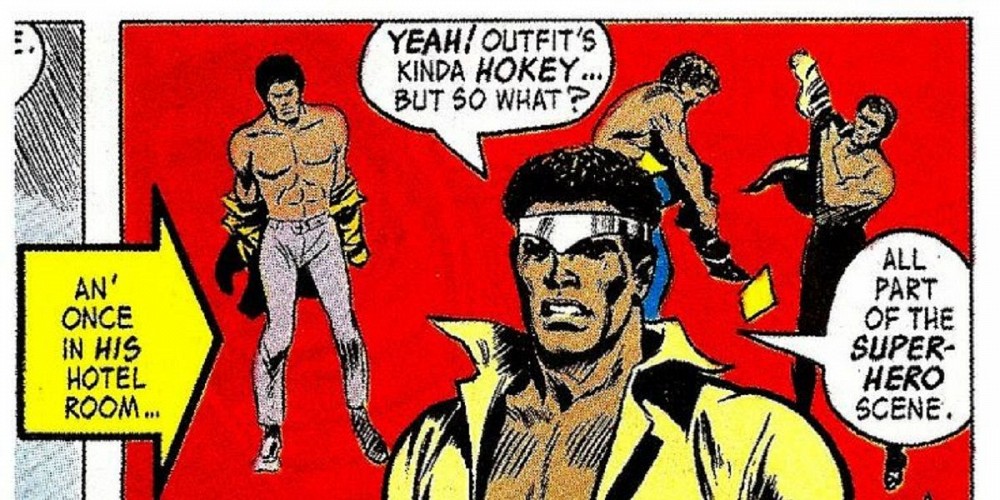
As a hero, Luke is definitely unconventional. Drifting from the Marvel moniker “with great power comes great responsibility,” Luke adopts the identity Power Man and becomes a hero for hire. This may seem outrageous in comparison to his heroic peers, but unlike those same peers, because Cage doesn’t traditionally “look” like a hero no one will take him serious as a one. This addresses the real life struggles countless African Americans have faced throughout the years; being just as qualified to perform a job duty, yet being overlooked simply because of skin color. Cage, however, does not let this deter him, and in the comics purposely creates a flashy outlandish costume to distinguish himself and draw attention to himself as a new bonafide hero to whoever can afford him. He in turns uses his powers for good, but more importantly maintains a way to support himself in a world not very supportive of black men.
Ultimately the greatest cultural significance of Luke Cage is his super durable and impenetrable skin. In an age of Black Lives Matter and rampant police brutality throughout the country, it’s no secret how handy having bulletproof skin can be, especially for a black man living in America. As Marvels first mainstream televised black superhero, Luke Cage proudly (and effortlessly) pays homage to the many lives lost to police brutality from the recent killing of Keith L. Scott to Trayvon Marton, who inspires the hero’s live version signature hoodie. While Marvel’s previously explored heroes are no strangers to taking on crime filled cities and corrupt police officers and politicians, Luke Cage is the first to do so while alluding to real-world scenarios and issues helping to solidify the character’s cultural appeal and impact.
*The first season of Luke Cage premiered on Netflix September 30, ’16 and within the first weekend caused the streaming service to crash.*