Showing posts with label Luke Cage. Show all posts

Black Lightning Finale Misfire

The era of the televised black superhero television series has come to an end, or at least for now, it has with the series finale of the CW's Black Lightning. After four seasons, the Pierce family is saying goodbye, and with news of the Painkiller series not being picked up this will perhaps be the last time we see the full cast together. Complete series finales are always a hit and miss, and unfortunately, the Black Lightning finale was a miss. For every the Wire and Golden Girls, there’s a Lost or Game of Thrones and the CW show follows the latter. There’s a lot to look into when considering what lead to the ending of the series. If not the leaving and recasting of a day one series regular, and a loyal fan base, the only thing that could have derailed the momentum of the show is the CW network itself, and its lack of interest. 

Black Lightning premiered at a time when the Black male superhero was in high demand. The character Black Panther stole the show in Captain America Civil War and was on the way to having the highest-grossing film for marvel at the time, and Luke Cage was receiving rave reviews for its debut season on Netflix. Even minor characters were being featured in shows such as Runaways, the Flash, and Arrow. Black superheroes were everywhere once, but despite the critical reception at the time black superheroes are now scarce when it comes to television. Luke Cage was canceled after two seasons, and the world suffered the loss of Chadwick Boseman changing the entire direction of the Black Panther Franchise. Even minor black superheroes such as Kid Flash, and Vixen, from Flash and Arrow, have been shelved, and with the cancellation of Black Lightning, Batwoman is officially the only series airing featuring a predominant black superhero. (More on the future of the black female superheroes to come.)

The network seems to have lost faith in the future of the series, and black male superheroes altogether. While the series attempts to tie all threads together nicely, the finale suffers from having too much too soon. As Charles Pullium-Moore pointed out in his piece the hour alone isn’t enough time to service and send off each character successfully, and many major points feel packed and rushed to fit into the finale. And while the finale attempts to plant seeds of the future, news of the Pain Killer series not being picked up diminishes any hope of seeing the heroes in the future.


With this said, Black Lightning definitely deserves its flowers. The series set a precedent for incorporating real-life issues into its storylines, beyond the go-to trauma story of near-death encounters between police and African American characters. Throughout the seasons the series touched on gentrification, the school to prison pipeline, illegal health experimentations, inner-city gang violence helping to keep the series grounded in a sense of reality missing from most of its CW peers. The villains were just as captivating as the series heroes, and no hero was above being believably flawed. And while the show originally played into the trend of capitalizing off the popularity of the black superhero the series was also the first series to showcase black female superheroes predominately. Unfortunately, for all the good the series has presented the finale definitely tarnishes its legacy. 


What do you think? Are you glad the series has ended? 

Year of the Black Superhero


2018 is shaping up to be another monumental year for readers of comics and fans of its televised and cinematic counterparts. This is especially true in the instance of Black characters. After 10 years ( 17 marvel films, 5 DC films) African American comic characters and superheroes are finally being brought to the forefront and leading their own films and series. Thanks to the critical success of the Netflix series Luke Cage, the Marvel execs may have finally realized that they can draw in Black viewers without the act of race bending characters in an effort to reflect "diversity" (i.e. raise ticket sales) and as a result 2018 will be the biggest year for African American superheroes to date.

Marvel is pushing fufther into its 'diversity' frontier preparing for the company's first feature starring an African American male as the lead with 2018's Black Panther. Completely stealing the show in Captain America: Civil war, Chadwick Bossman' s Black Panther is one of the most recognized and beloved Avergers surpassing Stark's technology, Banner's intellect, Thor's honor, and Roger's leadership. Premiering in February, the movie will follow his return to Wakanda, as he deals with the aftermath of the death of his father and his own ascension to the throne.

While it's no surprise that Luke Cage will return to Netflix with a second season next year, it isn't the only streaming service getting in on comic adaptations with Hulu also throwing its hat into the ring this November. The adaptation of the Marvel comic The Runaways will feature African American team leader Alex Wilder, a genius who learns that his parents are actually super villains.
And on the small screen things are growing even bigger for the CW as the network prepares for the premier of its new series Black lightning, based on the DC character, which will feature television's first primetime black superhero family. (http://unorthodoxwisdom.blogspot.com/2017/10/blacklightning-and-first-black.html?m=1)

Although there continues to be a lack of Black female super characters on television and film, this list will also grow with the inclusion of Black Lightning's daughters Thunder and Lightning, while The Legends of Tomorrow continues to brilliantly highlight the DC character Vixen, and Luke Cage will transition Misty Knight towards her heroic calling.
With each of these shows 2018 will be the year with the most black superheroes in movies and television, and if this is any indication of what's to come in the future then we are in for a spectacular ride. (Honorable mention to Arrow's John Diggle and Mr. Terrific, Guardian from Supergirl and the Flash's Wally West).

Black Lightning and the First Black Superhero Family

DC comics latest live-action series, Black-lightning, is set to debut next year and will finally deliver audiences an African American super hero family.

The hero debuted in his own issue in 1977, running 12 issues, before being canceled. Despite this, his popularity persisted leading to a number of team mashups, affiliations, and reincarnation series in the years to follow. Now the hero is headlining his own television series. Real name Jefferson Pierce, Black Lightning's power of spontaneously producing electricity from his body allows him to manipulate it to grant him flight and create force fields. 

Of course, what makes Jefferson so special isn't his powers but his family. Eventually, Jefferson decides to give up crime fighting to raise his two super-powered daughters Anissa and Jennifer who would grow up to become the heroes Thunder and  Lightning. Lightning takes after her father in having the ability to control lightning, but she also has the power to transform into lightning itself. Thunders' power allows her to alter her density at will, and she can send shockwaves through the ground by stomping. It should be noted that in the comics the girls don't become active heroes until after graduating college, so expect the television series to deal with their ages differently.

While it doesn't seem like a milestone even in this age of comic-inspired movies and television seeing a family of superheroes is a rarity. The former includes the Incredibles and Sky High, both featuring Caucasian families, and products of Disney. The only other preexisting African American superfamily is from the Disney channel original movie Up, Up, and Away (2000). A previous attempt at a tv series following a family with powers aired on ABC for 1 season in 2010, but that family too was not of color.

While hopes were, and still are, high for a series crossover between Black Lightning and the major Arrow-verse series chances remain slim as unlike the others Black Lightning is being filmed in Atlanta, therefore now it remains separate from the established shared universe. However, Supergirl also went through its premier season without being a part of a the Arrowverse, so there's still hoping if the pilot and season do well.

Black Lightning premiers 2018 on the CW.

Luke Cage: The Unlikely, Uncanny, Cultural Icon

It has been twelve years since Marvel  last produced a superhero interpretation featuring an African American lead, and with the arrival of Luke Cage many of us can stop holding our breaths and rejoice ‘it’s about time.’ Starring Mike Coulter, Luke Cage arrives on Netflix as the premier superhero for hire and in an age of Black Lives Matter protest and rampant police brutality throughout the nation Luke Cage definitely resonates a lot with today’s modern issues. Yet, undeniably the hero has always signified the struggles persons of color, particularly men, have faced living in America throughout the years.
            First created and introduced by Marvel in 1972 during the Blaxploitation era, the initial character of Luke Cage was at first a stereotypical, comic relief character. Today (thankfully) that isn’t so much the case. One thing that sets Luke apart from other heroes is the origin of his powers. The backdrop to his origin is that Luke, real name Carl Lucas, is sent to prison after being framed for possessing drugs. This parallels with real life events and the corrupt American  justice system which disproportionately gives harsher sentences to African Americans for crimes than it does white peers who commit the same offenses. There are some who would argue against this but look at the case of Brock Turner as compared to that of Cory Batey.
It is in prison that Luke selected by a scientist to be used for experimentation. This too parallels the troubles African Americans have faced throughout the years as it is an allusion to the Tuskegee syphilis experiments that were enacted on African American men who were tricked into believing they were receiving health care when indeed they were being injected with the disease. In the comics, Luke is enlisted as a volunteer, for money purposes, yet is never disclosed the true intent of the experiment. Due to interference from a sadistic guard, who enjoys torturing Luke, the experiment goes awry and Luke gains his enhanced strength and unbreakable skin allowing him to escape prison and return home to Harlem where he would eventually become the hero Power Man.
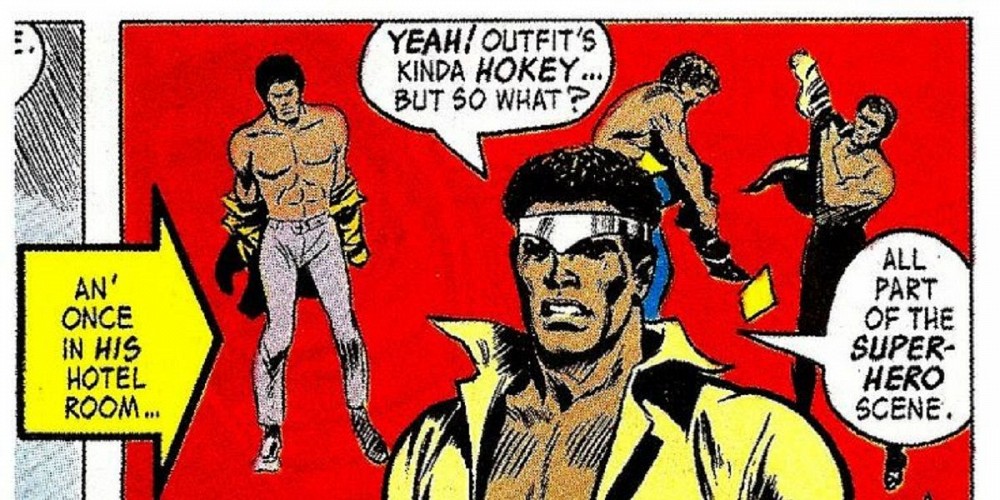
As a hero, Luke is definitely unconventional. Drifting from the Marvel moniker “with great power comes great responsibility,” Luke adopts the identity Power Man and becomes a hero for hire. This may seem outrageous in comparison to his heroic peers, but unlike those same peers, because Cage doesn’t traditionally “look” like a hero no one will take him serious as a one. This addresses the real life struggles countless African Americans have faced throughout the years; being just as qualified to perform a job duty, yet being overlooked simply because of skin color. Cage, however, does not let this deter him, and in the comics purposely creates a flashy outlandish costume to distinguish himself and draw attention to himself as a new bonafide hero to whoever can afford him. He in turns uses his powers for good, but more importantly maintains a way to support himself in a world not very supportive of black men.
Ultimately the greatest cultural significance of Luke Cage is his super durable and impenetrable skin. In an age of Black Lives Matter and rampant police brutality throughout the country, it’s no secret how handy having bulletproof skin can be, especially for a black man living in America. As Marvels first mainstream televised black superhero, Luke Cage proudly (and effortlessly) pays homage to the many lives lost to police brutality from the recent killing of Keith L. Scott to Trayvon Marton, who inspires the hero’s live version signature hoodie. While Marvel’s previously explored heroes are no strangers to taking on crime filled cities and corrupt police officers and politicians, Luke Cage is the first to do so while alluding to real-world scenarios and issues helping to solidify the character’s cultural appeal and impact.
*The first season of Luke Cage premiered on Netflix September 30, ’16 and within the first weekend caused the streaming service to crash.*